


David Wards 10 minute rule bill to 'Save Our Cheque' full text
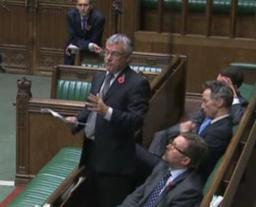
David Ward MP presents 'Save Our Cheques' Bill to Parliament
What have the Federation of Small Businesses, Age Concern, Help the Aged, Unite, Which?, Royal National Institute of Blind People, the Institute of Fund-raising and an EDM signed by 126 MPs from all parties, all have in common?
The answer is that they all have major reservations about the scrapping of cheques. This preferred method of payment is used by hundreds of thousands of people every single day. In fact the total number of cheques written out each day is close to 4m - that amounts to over 1.3bn in a year.
Yet, despite this very clear message that cheques are still valued by the customers of the major banks and other payment service providers, The Payments Council agreed last December on their behalf, to scrap cheques in 2018.
This decision will, I believe, have major ramifications.
Some may ask "what is the rush?" Why do we have to take action now to head off the threat of cheque abolition in 2018? After all we are led to believe that the final decision will not be made until 2016 - however if the Payments Council can set their own criteria and targets for the abolition of cheques, they also have the power to try and make the abolition of cheques a foregone conclusion before 2016.
And what about the argument that this is simply a business decision to reduce costs which can then be passed on to customers? Well this would hardly be a shining example of the free market at its best as what would in effect be a cartel collectively agreed en bloc to remove from the market a service knowing that no individual bank could do anything to stop it.
This is not a Bill borne out of nostalgia for the past but for an acceptance of the present. This is not a bill to attack the independence of businesses but a bill to protect the rights of their customers. And this is not a Bill to condemn customers to an outdated method of carrying out financial transactions but a Bill to give all those carrying out such transactions greater choice about how they do so.
The truth is that setting an end date for cheques will inevitably accelerate the process by which businesses stop accepting cheques and individual banks stop issuing them, making the demise of the cheque a self fulfilling prophecy.
This said, the Payment Council has forecast that, should we not stop them with this Bill, then on its death bed in 2018 there will still be 2 million cheque transactions taking place every day. Some chicken, some neck!
I have referred to my concerns about what I believe will be the major ramifications of cheque abolition but I am here to voice the concerns of some of the groups I have already mentioned.
The Federation of Small Businesses has strongly argued that the abolition of cheques will have a detrimental effect on smaller firms.
For many small businesses cheques represent the most convenient system. They provide an excellent audit trail, are easy to reconcile and require minimal administration.
Far from achieving our stated aim of decreasing the burden on small and medium-sized enterprises, switching away from cheques could increase it.
Many clubs, charities and societies receive the overwhelming proportion of their donations in the form of cheques.
While larger organisations have the facilities to process other means of payment it is the small, local organisations reliant on volunteers who will suffer. They are worried that many of their supporters are far less likely to use other methods if cheques were unavailable.
Blind and partially sighted people are particularly reliant on cheques. One of the most compelling pieces of evidence to the Treasury Select Committee enquiry on cheques came from the RNIB. Its members feel cheques give them a greater sense of control. They are able to sign them and check the figures with a magnifying glass whereas with chip and pin it is almost impossible for them to read and check the figure they are paying.
But the largest group who are by far the most reliant on cheques are the elderly. This is partly out of habit and partly out of necessity. They are also the group who will find it hardest to adopt alternatives.
The Payments Council's projections assume that there will never be a time at which cash will be substituted for cheques. Well the evidence from abroad suggests the exact opposite. The fewer cheque transactions a country has the more they use cash.
Overall my concern is that people will move back to cash and start to keep large volumes of money in their houses, making them vulnerable to theft. We do not want to see older people keeping wads of cash under their mattresses to pay for day to day necessities and outside help.
Cheques allow older people who are housebound the ability to manage their finances independently, whether it be paying the paper bill or a little something enclosed with a card to the grand kids.
Behind the proposal of the Payment Council is a belief no doubt that - and there is no delicate way of saying this - many of the existing elderly cheque users will not be around in 2018 - but UK Uk's latest edition of its political bulletin reveals that 64% of people aged 65 and over have never used Internet internet and let us be realistic, are never likely to engage in on-line banking.
Despite the inconvenience they cause to the Payment Council I wish all those who took part in UK Uk's research a long and happy cheque-using life.
We have so focused focussed on whether it is wise to remove the option of cheque use. But there is a further issue. Who should make the decision?
We may in this place agree or disagree with the decision to scrap the cheque, but surely we can find common ground on the view that the decision is too important to be left to the Payments Council?
8 out of the 28 members of the Payments Council do not even offer current accounts with cheque books. Many are foreign owned banks. Many are businesses based on alternative methods of payment, such Pay Pal PayPal and Cash Zone, who would be the major beneficiaries of a decision to abolish cheques. And yet they would still have a say in whether or not the UK should retain its centralised cheque clearing system. Can this be right?
This is not a purely financial consideration but a matter of public interest.
I believe that the consideration of the demise of the cheque should be made by a body that has the independence, objectivity and the competence to balance the needs of consumers with the savings to the banks, but further, I would argue that any final decision should be made by a body accountable to Parliament.
I urge members to support my bill, which will bring cheque payments under the consumer protection remit of the Financial Services Authority, or any subsequent body.
I just need to conclude by saying that though I am new to this house I am a late arrival to this worthy cause. I want to thank my colleagues Mark Hunter and Lorely Burt for taking a lead on launching the campaign to save the cheque, and the hon. members from other parties who have kindly agreed to allow their names to be added to this bill as supporters.